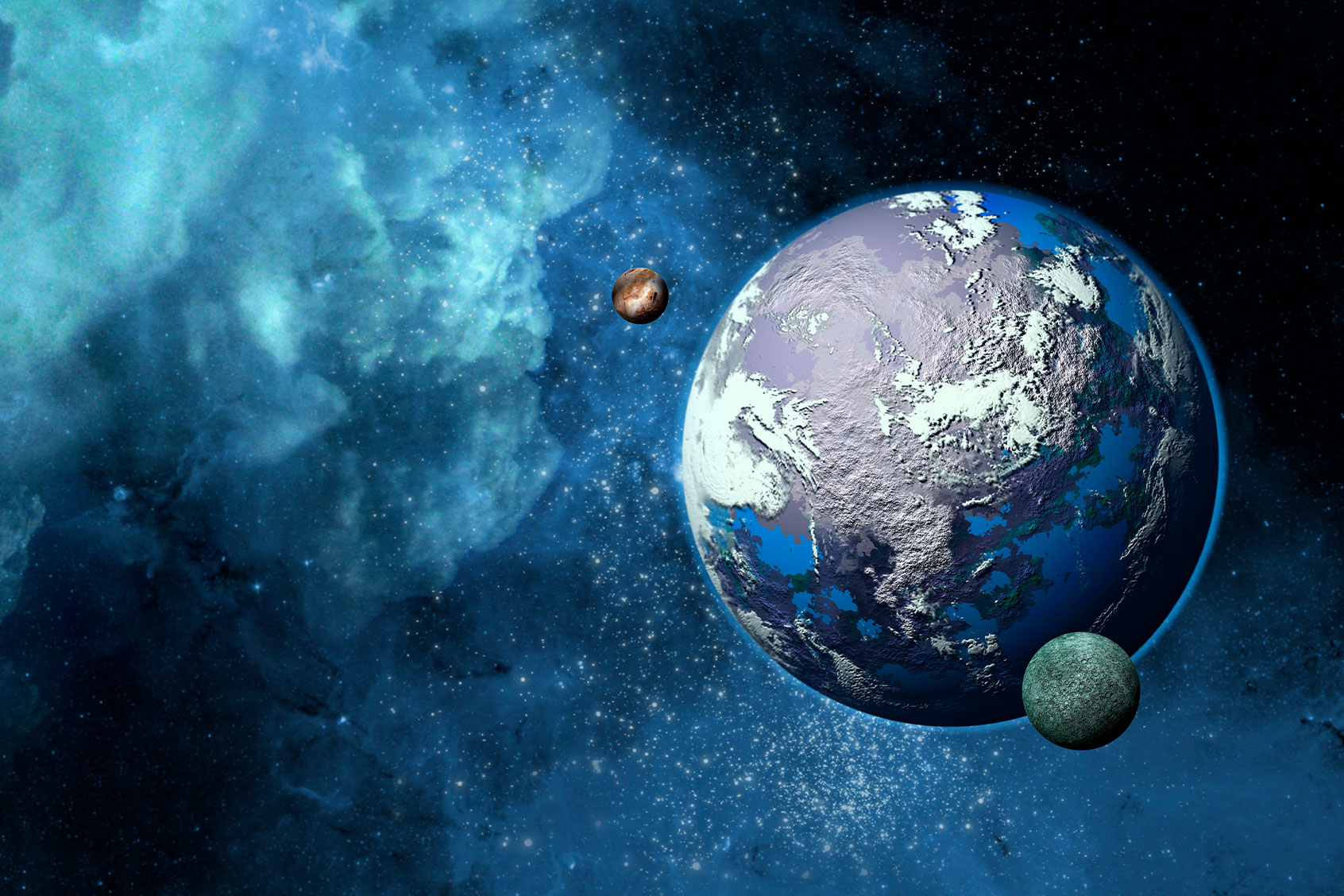
For centuries, humans have wondered, “Are we alone in the universe, or is there life beyond our world?” This curiosity has driven humans to search for other planets in the vast universe. Humans are also trying to understand how our world was created by exploring exoplanets. Astrobiologists have already explored the origin, evolution, and distribution of life on Earth. They now hope to understand the nature of life better and whether it could exist on planets other than Earth.
To hunt exoplanets, several space agencies such as NASA, European Space Agency, and Canadian Space Agency have been sending missions beyond Earth’s atmosphere. Missions such as the James Webb Space Telescope (a joint mission of NASA, ESA, and CSA), ESA’s CHEOPS (Characterising Exoplanet Satellite), as well as ESA’s upcoming PLATO (Planetary Transits and Oscillations of Stars) and ARIEL (Atmospheric Remote-sensing Infrared Exoplanet Large-survey), along with NASA’s long-serving Hubble Space Telescope, have paved the way for future astrobiology research by allowing scientists to study exoplanets and identify which types of planets outside the Solar System could be suitable for life.
So far, scientists have discovered more than 6,000 exoplanets, and the search for new worlds continues. Space telescopes and ground-based telescopes search for exoplanets day in and day out. Scientists must choose which planets to focus on from among 700 quintillion to over 10 septillion planets. Humanity resides on a planet uniquely suited for life, positioned within the habitable zone of the Sun — often called the “Goldilocks zone,” where conditions are just right for liquid water to exist. Using this same principle, scientists search for potentially habitable worlds beyond our Solar System. One such discovery is TOI-1452 b, a possible water world located about 100 light-years away, orbiting a cool dwarf star.
In the search for habitable exoplanets, scientists have discovered planets of many shapes and sizes. Some are not habitable at all; some are similar to Jupiter, Neptune, or Uranus; and others are rocky like Earth. This is where terms such as “super-Earth,” “mini-Neptune,” and “mega-Jupiter” come from. So far, scientists have yet find a planet habitable for life.
The closest known exoplanet lies about four light-years from our Solar System. With current rocket technology, reaching it would take millions of years. Because direct exploration is not yet possible — such as physically searching for microbial life in alien oceans or rivers — scientists must rely on indirect methods to evaluate whether these distant worlds could support life.
Most exoplanets are discovered using indirect techniques that observe changes in a star’s brightness or motion. In some cases, astronomers can also detect faint light coming directly from the planet itself. Two of the most productive detection methods are Transit Photometry, which measures tiny dips in a star’s brightness when a planet passes in front of it, and Radial Velocity, which detects subtle stellar wobbles caused by a planet’s gravitational pull. Together, these methods have led to the discovery of thousands of distant worlds.
Space telescopes such as the James Webb Space Telescope and the Hubble Space Telescope — and in the future, ARIEL — use a technique known as transmission spectroscopy to study exoplanet atmospheres. This method analyses starlight that passes through a planet’s atmosphere, helping scientists identify its chemical composition.
With this technique, when an exoplanet passes in front of its star, a small portion of the star’s light travels through the planet’s atmosphere before reaching the telescope. Gases in the atmosphere absorb specific wavelengths of this light, creating distinctive patterns in the observed spectrum. By examining these patterns — often described as chemical “fingerprints” — scientists can determine which molecules are present in the planet’s atmosphere.
When scientists examine the spectrum of an exoplanet’s atmosphere, they search for specific molecules and chemical patterns that could suggest habitable conditions — or even processes that might be linked to life. These potential chemical indicators are known as biosignatures.
However, exoplanets come in many varieties, with environments and chemical compositions that may be very different from Earth’s. Because of this diversity, a molecule that signals life on one world might not necessarily mean the same thing on another. Interpreting these signals requires careful analysis and an understanding of each planet’s unique conditions.
This creates one of the greatest challenges in modern astronomy. These distant worlds lie so far away that we cannot witness life directly, nor can we journey there to investigate them first-hand. All we have are whispers of light travelling across the cosmos — and from those whispers, we must uncover the truth.