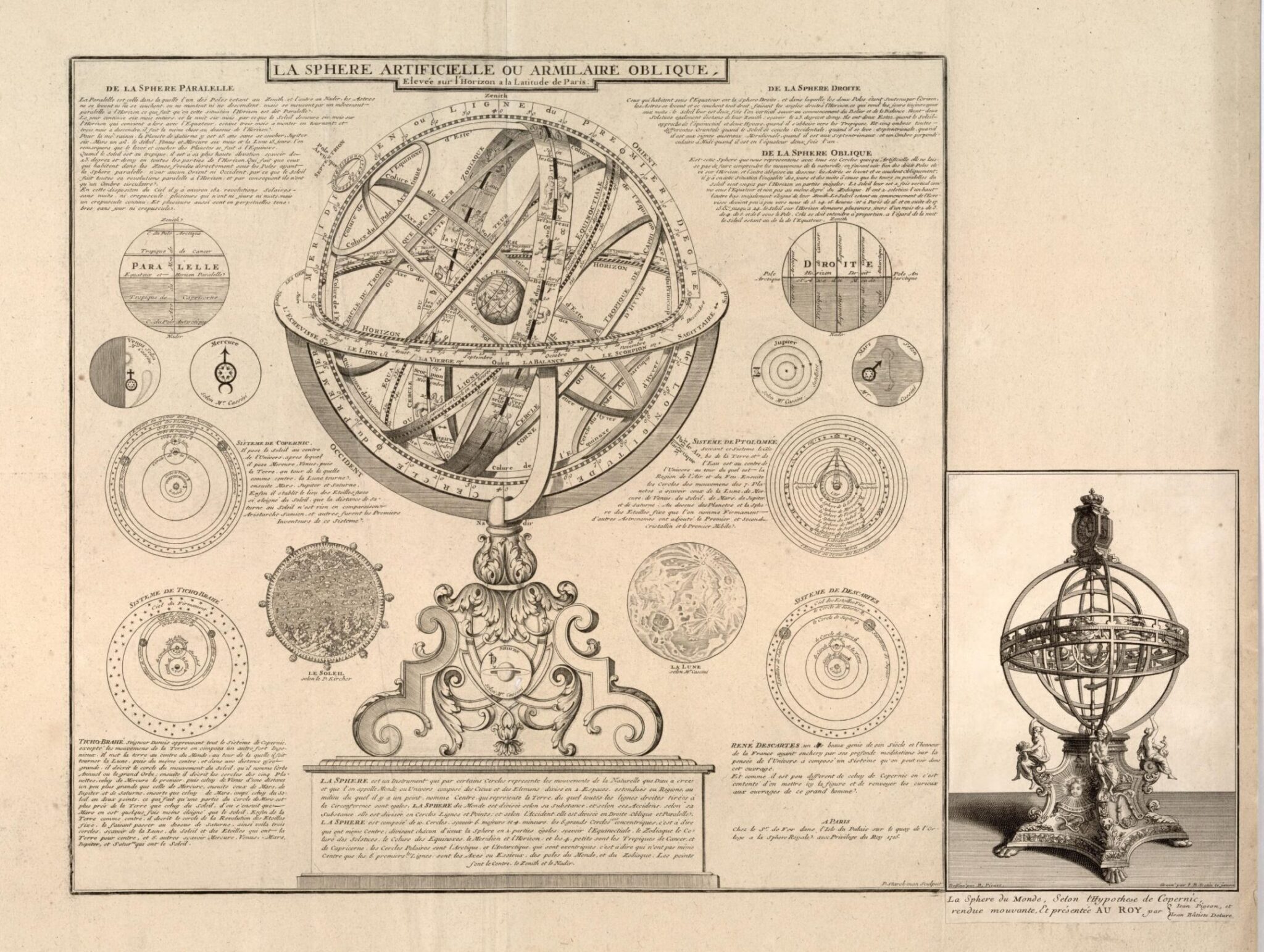
An armillary sphere is a model of the universe used by ancient humans to examine stars in the heavens (Universe)
One of the earliest natural disciplines, astronomy was used by early humans to interpret omens and divine signs, navigate, and cultivate crops by understanding celestial cycles. Early humans were fascinated by observing the night sky, which helped them to learn that celestial objects occasionally shift positions. In an effort to make the motions of the stars and other celestial bodies understandable to the average person, humans have tried to depict the wonder of the cosmos. This led early humans to create the Armillary sphere, an instrument for monitoring the movement of astronomical objects.
People in ancient times thought of the Armillary sphere as a model of “earlier heaven,” today’s universe. It has a central globe, which represents the sun, and a framework of rings around it that stand for celestial bodies and features. It features a globe with a diameter of just three inches in the centre. Red dots were used to indicate significant cities because the globe was too small to include all of the city names. The map of the globe was hand-drawn. There is an unusual characteristic about the globe that leads us to the uncertainty of whether Asia and America were a single landmass at the time.
The globe is enclosed within a series of eleven overlapping armillary rings that represent the revolution of the sun, moon, and stars in the Ptolemaic tradition, implying that the Earth is at the centre of the cosmos. The rings around the Armillary Sphere represent the equator, the Tropics of Cancer and Capricorn, equinoxes, polar circles, and the sun’s ecliptic circle. Some of the rings could be moved to align with specific stars during different seasons. The signs of the Zodiac are inscribed on the ecliptic ring.
The origin of the Armillary sphere is still contested. However, the Chinese and Greeks are claimed to have invented the object separately as early as the fourth century BCE. The Armillary sphere was described by the Greek astronomer and mathematician Eratosthenes, as well as the philosopher Ptolemy. Chinese astronomers such as Luoxia Hong created advanced versions by the first century BCE. Ironically, this globe was created the same year that Nicolaus Copernicus published his heliocentric model of the universe. The mathematical model that explains the way the Earth actually rotates around the sun. That transformed the concept of the universe. However, Indian philosophers informed the world long before Copernicus.
Humans, ancient and modern, have long craved the universe. The enormous ocean of darkness and light has always fascinated the human intellect. Several astronomers attempted to understand, and continue to do so, using various instruments. Previously, early humans utilised simpler instruments like the Armillary sphere, while current humans employ more powerful equipment like the James Webb Space Telescope. But still employing essentially the same principle as they did in Armillary, now only using infrared waves.
When writing about the romance of collecting in 1907, Herbert Putnam mentions the tale of discovering this globe in a Hamburg, Germany, store.
Looking back over the six years of my association with the National Library, I can recall but a few instances of “romance” consisting either in the circumstances of the purchase or in the character of the thing acquired…
Passing through Hamburg a short time ago, and having an hour for a bibliographic stroll, I happened in at the office of a prominent publisher of maps. I had looked for nothing there but current material, and called merely to request that we receive all catalogues issued. By chance the proprietor entered as I was leaving and we sat down to chat. I was again leaving when he asked if I was interested in globes – old globes. I was – mildly. He went to his safe and extracted from its depths a tiny package which he carefully unwrapped and set before me. It was a globe of not more than four inches in diameter, but setting forth with distinctness the main continents, including America, and containing many geographical data now curious. It was set upon a stand and looped with brass zones delicately engraved after the fashion of two hundred and fifty years ago. On one of these was the legend – “Caspar Vopell artiv. Profes. hanc sphaeram faciebat Coloniae 1543.”