Following the tremendous success of “Operation Sindoor” and the retirement of the iconic MiG-21, India is rapidly heading towards “Mission 42.” What is Mission 42? It is the Indian Air Force’s ambitious program to increase its squadron strength from 29 to 42.
India is a strategically located landmass that dominates the Indian Ocean in the south. In the north, the formidable Himalayas safeguarded the region from invasions during ancient and medieval times. However, the Himalayas can no longer offer the same protection due to sophisticated weapon systems and advanced protective gear used by soldiers—particularly the Chinese and Pakistanis—which allow them to operate in the bone-chilling cold of the high-altitude regions.
India faced a Chinese incursion during the COVID-19 pandemic, a time when the world was scrambling for medical supplies. The top Chinese leadership ordered their forces to invade and seize Galwan. Indian soldiers fought bravely to defend their nation. Since then, there has been growing concern about the Chinese PLA Air Force’s construction of airstrips in Tibet.
India has faced the threat of a two-front war since the formation of Pakistan. Pakistan—an artificial nation ruled by military autocrats—has been used by China and, at times, Western countries to create disturbances within India. These include direct wars in 1965, 1971, and 1999, and repeated acts of terrorism disguised as non-state actors, as seen during the 26/11 Mumbai attacks, one of the most heinous acts on Indian soil—akin to 9/11 in the United States.
Since the Kargil War in 1999, India has been grappling with an ageing fleet and a shortage of fighter aircraft. Recognizing this, former Prime Minister Atal Bihari Vajpayee strongly advocated for indigenous aircraft development. This led to the birth of the Tejas Mk1, and eventually, the twin-engine Tejas Mk2.
However, India has yet to achieve the 42-squadron target. The primary reason is the lack of indigenous fighter jet engine technology. India remains dependent on General Electric (GE) for its F404 and F414 engines. Engine deliveries are under U.S. control, and Washington has often used this leverage to influence India, primarily to safeguard its own fighter aircraft market.
India is currently negotiating with France’s Safran and Britain’s Rolls-Royce for 100% technology transfer and the domestic production of engines under the “Make-in-India” initiative. The Indian Air Force has already placed a ₹48,000 crore order for 83 Tejas Mk1A aircraft (73 fighters and 10 trainers), which are to be delivered by HAL by 2029. In August 2025, the Cabinet Committee on Security (CCS) approved the acquisition of 97 more Mk1A jets, with deliveries expected to begin between 2027 and 2028, and conclude by 2032-2033.
Meanwhile, India has made a compelling case for acquiring Made-in-India Rafale aircraft, along with 140 naval variants, with the total likely to reach 176 aircraft. India is also advancing towards the production of the twin-engine LCA Mk2, though it remains in the pre-production phase due to ongoing engine-related challenges.
India is simultaneously working on developing its first fifth-generation fighter, the Advanced Medium Combat Aircraft (AMCA). Although it has only recently completed the design and development stages, several Indian companies—including Hindustan Aeronautics Limited (HAL), Larsen & Toubro (L&T), Tata Advanced Systems Ltd (TASL), Adani Defence, Kalyani Strategic Systems, and others—have submitted bids to collaborate with DRDO on the AMCA project.
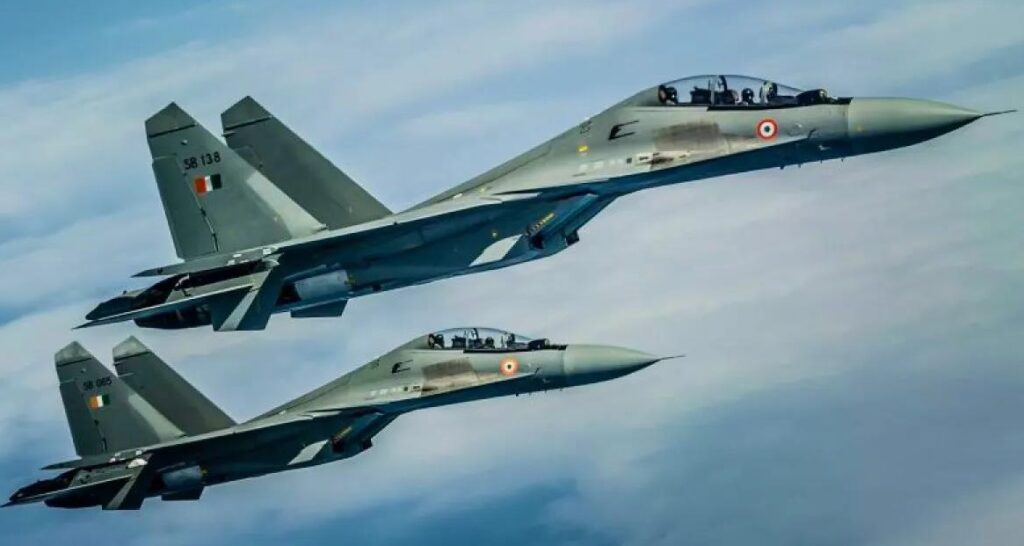
India is also upgrading its Su-30MKI fleet. In response to India’s growing demand for advanced fighters to counter the dual threat posed by China and Pakistan, Russia has offered the Su-57 stealth fighter. If acquired, the Su-57 would become the crown jewel of India’s air arsenal, placing India in the elite club of nations possessing exceptional stealth capabilities.